
By The HighVista Private Credit Team
Important Disclosure:
The views and options expressed here reflects the judgments and opinions of the authors at the time of writing, does not purport to be complete, and are subject to change. No obligation to update or otherwise revise such views and opinions is being assumed. This discussion does not constitute, and should not be construed as, an offer of advisory services, securities or other financial instruments, a solicitation of an offer to buy any security or other financial instrument, or a recommendation to buy, hold or sell a security or other financial instruments in any jurisdiction. References to specific securities, issuers, and strategies are for illustrative purposes only, may or may not be currently held by HighVista Strategies LLC in a direct or indirect capacity, and are not intended to be, and should not be interpreted as, an indication that an investment has been or will be profitable. Use of information from sources referenced herein does not represent any sponsorship, affiliation, or other relationship between HighVista or the speakers, and any other company or entity, and does not constitute an endorsement. Nothing contained herein constitutes investment, consulting, legal, tax, accounting, or other advice, nor is it intended to be relied on in making an investment or other decision. Information provided herein is based upon data and analysis that is believed to be accurate as of the time of writing, but no representation or warranty is made herein. Any reproduction or distribution of this presentation, in whole or in part, or the disclosure of its contents, without the prior written consent of HighVista is prohibited. THIS PRESENTATION CONTAINS FORWARD-LOOKING STATEMENTS WITHIN THE MEANING OF THE U.S. FEDERAL SECURITIES LAWS. FORWARD-LOOKING STATEMENTS ARE THOSE THAT PREDICT OR DESCRIBE FUTURE EVENTS OR TRENDS AND THAT DO NOT RELATE SOLELY TO HISTORICAL MATTERS. FOR EXAMPLE, FORWARD-LOOKING STATEMENTS MAY PREDICT FUTURE ECONOMIC PERFORMANCE, DESCRIBE PLANS AND OBJECTIVES OF MANAGEMENT FOR FUTURE OPERATIONS, PERFORMANCE AND RISK AND MAKE PROJECTIONS OF REVENUE, INVESTMENT RETURNS, RISK CALCULATIONS OR OTHER FINANCIAL ITEMS. FORWARD-LOOKING STATEMENTS CAN GENERALLY BE IDENTIFIED AS STATEMENTS CONTAINING THE WORDS “WILL,” “BELIEVE,” “EXPECT,” “ANTICIPATE,” “INTEND,” “CONTEMPLATE,” “ESTIMATE,” “ASSUME,” “TARGET” OR OTHER SIMILAR EXPRESSIONS. SUCH FORWARD-LOOKING STATEMENTS ARE INHERENTLY UNCERTAIN, BECAUSE THE MATTERS THEY DESCRIBE ARE SUBJECT TO KNOWN (AND UNKNOWN) RISKS, UNCERTAINTIES AND OTHER UNPREDICTABLE FACTORS, MANY OF WHICH ARE BEYOND CONTROL. NO REPRESENTATIONS OR WARRANTIES ARE MADE AS TO THE ACCURACY OF SUCH FORWARD-LOOKING STATEMENTS.
Specialty Finance Lending: Executive Summary
Specialty finance is a distinct subset of asset-based lending in which capital is extended not to operating companies, but to the lenders and originators that serve them. We believe creditworthiness is derived from the quality, enforceability, and performance of the underlying asset pool rather than from the EBITDA or enterprise value of the borrowing entity. Facilities can be are self-amortizing by design, with principal returning through the natural runoff of the asset pool. The structural architecture of specialty finance–encompassing short-duration pools, granular obligor diversification, and performance triggers that activate before losses reach the lender’s position–allows earlier detection of and response to deterioration, which we believe produces a return profile more resilient to credit cycle turns than corporate lending.
The asset classes financed through these originators are not peripheral to the economy. They are its connective tissue: the auto loans that put cars on the road, the trade credit that keeps retail shelves stocked, and the aircraft leases that enable commercial aviation. Regulatory constraints have progressively narrowed bank participation to the most standardized products, creating a financing gap that private credit has partially filled. A series of widely reported control failures across the specialty finance market in 2024 and 2025 created a further dislocation, though in our view these events were not inherent to the asset class but to the oversight practices of specific participants.
HighVista concentrates its specialty finance activity in the early and late growth segments of the originator lifecycle, deploying through bilateral, single-lender structures sized between $25 million and $100 million. Our five-pillar underwriting framework–encompassing Security, Collateral, Capital Structure and Unit Economics, Performance Triggers, and Originator Health (further outlined below)–enforces the structural protections that specialty finance theoretically permits, but what we believe the market has historically failed to implement with sufficient rigor. Forensic analysis of recent fraud events points to two root causes: insufficient lender oversight and untitled or unverifiable collateral, both potentially addressable through technology and process rather than additional intermediaries. The lower middle market, where originators have not yet achieved the scale required for public securitization, is, in our view, where the structural conditions for disciplined oversight are most achievable and the most compelling risk-adjusted opportunity resides.
The current dislocation creates the conditions for a structural reset. We are actively deploying into it, concentrating our activity on originators who have built the technology infrastructure to support oversight standards we believe are non-negotiable: direct API connectivity into borrower bank accounts and operational systems, enabling real-time cash reconciliation and collateral verification that removes the originator’s unilateral control over what lenders see. We do not believe technology eliminates bad actors. We believe it raises the bar for control failures and helps collapse the detection window in which undetected fraud can cause material economic damage. As the technology infrastructure underpinning specialty finance continues to evolve, we are actively monitoring emerging developments in collateral verification and real-time oversight, and we expect to deepen our partnerships with the originators and platforms at the frontier of that innovation.
Part I – Market Overview
Asset-based finance encompasses any credit strategy secured by physical assets or pools of contractual cash flows. Specialty finance represents a distinct subset of this universe, spanning four primary categories: SME finance, including small business loans and working capital facilities; consumer finance, including automobile loans, credit cards, and personal loans; commercial finance, including factoring, supply-chain finance, and receivables-based lending; and contractual cash flows, including royalties and trade receivables. Residential and commercial real estate mortgages, while part of the broader asset-based finance market, fall outside this definition.
Specialty Finance Sub-Asset Classes

Historically, banks were long a primary capital source for specialty finance originators. Basel III and subsequent regulations stemming from the Global Financial Crisis (“GFC”) disrupted this model, imposing higher capital requirements and stricter risk retention rules that pushed banks toward standardized, capital-efficient products. The resulting financing gap has attracted substantial institutional capital into specialty finance, with large private debt platforms seeking deployment and LPs diversifying away from traditional direct lending. Despite this influx, private credit currently holds less than 20% share of the estimated $6 trillion specialty finance market. The capital that has entered has congregated at the upper end, where many established platforms have access to rated ABS execution at tight spreads, compelling private lenders to accept looser structural protections to remain competitive on yield.
Illustrative Specialty Finance Market Capitalization1
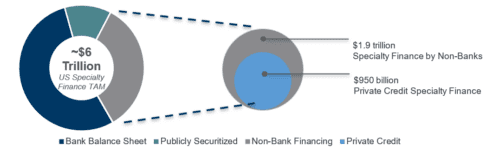
1 Source: HighVista Analysis and Estimates as of September 30, 2025, based on growth rates applied to base market sizing data sourced from Oliver Wyman analysis and estimates.
Specialty finance facilities are extended to originators and originator-owned special purpose vehicles (“SPVs”) whose repayment capacity is derived exclusively from the contractual cash flows generated by the underlying asset pool, independent of the operating performance of the borrowing entity. Collateral is explicitly secured by financial or real assets, with structural protections implemented through non-recourse SPVs that can insulate lenders from the broader bankruptcy estate of the originator. We believe underwriting centers on asset quality, cash flow predictability, and structural integrity rather than on balance sheet leverage or business model durability, requiring a degree of specialized asset expertise that meaningfully limits the pool of qualified capital.
Specialty Finance Market Segmentation
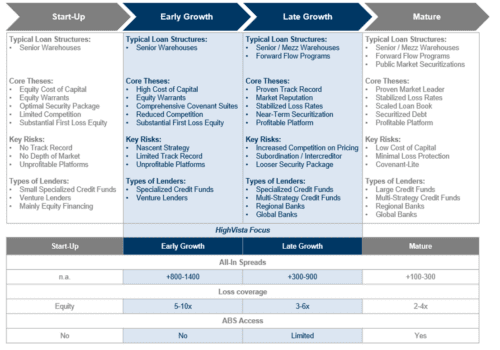
We categorize the specialty finance market into four distinct phases of originator maturity: start-up, early growth, late growth, and mature. Start-up originators rely predominantly on equity capital to validate their underwriting model, with only a small number of specialized private funds active at this stage. As an originator demonstrates the ability to manage a performing loan book, it enters the early growth phase, seeking warehouse financing from specialized lenders who typically target mid-to-high teens returns to compensate for elevated platform risk, frequently negotiating equity warrants and leverage capacity rights. Late growth originators access larger, more structured warehouse facilities at a reduced cost of capital, with financing structures becoming more flexible as advance rates increase and covenants shift to asset-level performance triggers. Once an originator reaches institutional scale, typically with a loan book exceeding $200 million, it gains access to the full range of low-cost financing channels, including competitively priced warehouse facilities, forward flow programs, and ultimately the public securitization market.
The following tables outline the key characteristics and economics of each phase:
Part II – Strategy & Investment Opportunity
HighVista concentrates on the early and late growth segments of the originator lifecycle, where we believe competition from both banks and large institutional debt funds remains limited. At this end of the market, originators have demonstrated sufficient performance to support conventional debt financing but have not yet achieved the scale required for public securitization, creating a persistent demand for specialized capital partners with genuine underwriting expertise.
Competitive dynamics in this segment continue to ease as large private debt platforms have increasingly sought to enter the specialty finance market through inorganic acquisition of established lower middle market and middle market specialty finance managers. These transactions have removed seasoned, relationship-driven competitors from the middle market and consolidated their origination networks within larger platforms that are less focused on this segment. For lenders with the requisite expertise to underwrite asset-level risk and structure facilities with appropriate protections, we believe this dynamic continues to widen the opportunity set where premium returns remain available without a commensurate increase in credit risk.
Specialty finance lending requires a structuring and monitoring discipline that is fundamentally distinct from corporate credit underwriting. Our analytical framework for viewing the market is organized around five core pillars2:
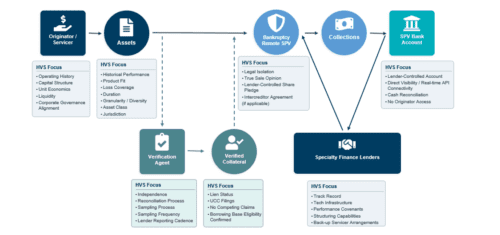
- Security: We favor bankruptcy-remote SPV structures supported by a true sale legal opinion confirming that the collateral assets are legally isolated from the operating business of the originator. Prior to closing, independent verification of the borrower and the underlying asset pool is completed to validate the integrity of the collateral being pledged. Lenders hold a perfected lien on the asset pool, with lender-controlled deposit account control agreements (“DACA”) providing direct visibility into collections as they are received and live cash reconciliations of the underlying receivables protecting against double pledging.
- Collateral: We prioritize short-duration asset pools, which compress the feedback loop between origination and performance observation, allowing lenders to identify deterioration and respond before losses accumulate. Granular pools with high obligor counts are preferred, as statistical predictability of pool-level behavior increases with diversification, reducing the sensitivity of aggregate performance to idiosyncratic credit events and increasing the bar to defraud at scale.
- Capital Structure and Unit Economics: We target transactions with four times or greater loss coverage, a threshold that exceeds stress levels observed across most asset classes during the GFC3. Loss coverage is assessed by analyzing the spread between the asset-level APR and the combined cost of financing and expected losses, in tandem with the originator’s retained first-loss equity position. We prefer warehouse facilities where the originator absorbs credit losses ahead of the lender’s position, viewing forward flow agreements as structurally inferior absent meaningful compensating protections.
- Performance Triggers: Facilities incorporate tight asset-level performance covenants encompassing delinquency rates, default thresholds, yield maintenance, and portfolio concentration limits, as well as continuous borrowing base mechanics that serve as a real-time covenant on collateral quality. Trigger breach automatically halts new funding and sweeps all cash flows to accelerated amortization, providing a rapid and contractual path to deleveraging before collateral value is impaired.
- Originator Health: We prefer transactions in which the originator is backed by an institutional equity sponsor with both the financial capacity and the incentive to inject additional capital in the event of underperformance. Minimum liquidity covenants are maintained at the operating company level to ensure sufficient cash runway to continue servicing the assets through periods of stress. Regardless of sponsor backing, a qualified backup servicer must be designated at transaction inception with a fully documented succession plan, live data feeds, and system access established prior to closing.
2 The five pillars described herein represent the primary factors considered in HighVista’s underwriting process and are not intended to be exhaustive. Additional criteria may be considered depending on the specific characteristics of a given transaction.
3 Source: Equifax Small Business Delinquency Index.
Illustrative Transaction Structure
Part III – Recent Market Trends
The five-pillar framework described in Part II represents a contractual architecture for enforcement that we believe corporate lending cannot replicate. That architecture is only as effective, however, as the discipline with which it is implemented. What the specialty finance market has experienced over the past several years is a documented and materially damaging series of control failures that demands honest accounting. The prevailing market response has been to characterize each event as isolated, the product of a specific bad actor in a specific asset class under specific circumstances. We reject that framing. Virtually every major fraud event we examined in specialty finance traces back to the same two structural vulnerabilities that present in different forms across different asset classes and geographies. What follows is not a concession about the asset class. It is a diagnosis of where and why structures that were sound in design failed in practice.
Our diagnosis begins with two structural conditions that the market has consistently underweighted: (i) insufficient lender oversight, where lenders failed to implement or continuously enforce the monitoring and verification controls their structures theoretically permitted; and (ii) untitled or unverifiable collateral, where the underlying assets were either not properly titled to the SPV, not independently verifiable, or capable of being pledged to multiple lenders simultaneously without detection. Untitled collateral refers to financial assets such as consumer loans, trade receivables, and merchant cash advances that, unlike real property or individually titled vehicles, carry no registration in a government-maintained registry independent of the borrower. While a UCC4 filing perfects a lender’s security interest as a legal matter, it does not independently confirm that each individual asset in the pool exists, is performing, or has not already been pledged to another lender under a separate filing. The originator controls the data tape entirely, and it is precisely that control, absent independent verification infrastructure, that creates the attack vector.
4 Uniform Commercial Code (UCC). A standardized set of laws governing commercial transactions in the United States. A UCC-1 financing statement is filed by a lender to publicly record and perfect a security interest in a borrower’s personal property, including financial assets such as receivables.
Market Case Study I: Tricolor Holdings (“Tricolor”)5
Tricolor was a subprime auto lender that funded its origination activity through multiple concurrent warehouse facilities, each secured by a pool of auto loan receivables. The vehicles underlying those loans carry state-issued titles, a feature that superficially distinguishes auto lending from purely untitled asset classes, but that distinction obscures the more important one: it is the loan receivable, not the vehicle, that lenders hold as collateral. Loan receivables are not registered in any government-maintained registry; the originator controls the data tape entirely, and based on public reports and court filings, that control is where the structure failed.
Each lender operated in isolation, relying on borrower-reported data and periodic audits with no cross-referenced, continuously updated record of which receivables were pledged to which facility. We believe that single condition made two forms of fraud simultaneously executable. It made double pledging executable: the same loans were allegedly encumbered across multiple facilities. And it made fabrication executable: alleged fake loans, fraudulent VINs, and simulated payments from non-existent borrowers were reportedly used to inflate the reported pool without triggering a single structural alarm. The most damning illustration is that a June 2025 securitization cleared the public market with apparently stable performance data just months before Tricolor filed for Chapter 7; the inevitable consequence of a verification regime built on snapshots rather than continuous visibility.
The receivables pledged were functionally untitled, and that condition demanded one of two responses: third-party verification processes capable of independently confirming collateral existence and exclusivity before each advance, or real-time monitoring infrastructure that removed the originator’s control over what lenders could see. Neither existed. The fraud window stayed open across a syndicated structure where no single lender had the visibility or the unilateral authority to close it. Tricolor was not an idiosyncratic failure of one bad actor. We believe it was the foreseeable result of a market that had confused legal perfection with actual verification.
5 Sources: HighVista Analysis, aggregated from a range of sources including, but not limited to, U.S. Department of Justice Press Release, McDonald Hopkins.
Tricolor Illustrative Transaction Structure6
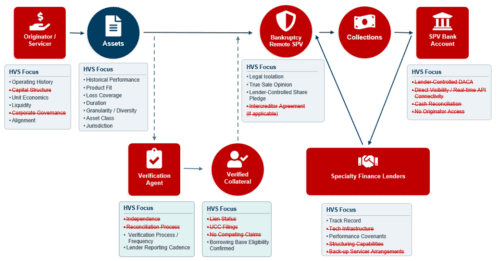
6 Red indicators within the diagram denote structural controls identified as absent or inadequate based on publicly reported information and court filings. Green indicators denote controls assessed as present and functioning. This illustration is provided for informational purposes only and reflects HighVista’s analytical assessment of publicly available information.
Market Case Study II: Broadband Telecom7
Broadband Telecom was a privately owned telecom service company that used accounts receivable as the collateral base for a multi-lender financing structure. Those receivables represented contractual payment obligations from telecom customers, assigned to the lending structure as the basis for advance eligibility. Accounts receivable are inherently untitled. There is no centralized registry nor a government-maintained record of ownership; the originator controls the data tape entirely, and no lender has any independent mechanism to confirm that the assets being pledged are real, performing, or free of competing claims. Based on publicly reported information, the company was accused in October 2025 of fabricating the receivables pledged as collateral, with aggregate lender exposure exceeding $500 million at the time the alleged fraud was discovered.
Fabricated receivables went undetected across multiple lenders because no lender was performing real-time verification of collateral existence against the obligor records or payment systems that would have confirmed whether the receivables were genuine. Lenders were relying on borrower-reported data, and without API-level connectivity to the systems that generated and tracked those receivables, the fraud could be sustained and scaled without triggering any structural alarm. The circularity here is the point: because the collateral was untitled, periodic oversight could not compensate for the absence of independent verification, and because oversight was periodic rather than continuous, the untitled nature of the collateral was never exposed. Each condition made the other worse.
Where collateral carries no verification anchor of any kind, periodic oversight is not merely insufficient. We believe it is structurally incapable of detecting fraud regardless of its frequency or rigor. The only mechanism capable of closing that gap, in our view, is one that removes the originator’s control over what lenders see entirely: direct, real-time access to the billing and payment systems that generated the receivables in the first place. These are not two different stories about two different bad actors. They are the same story about the same two structural failures, expressed in different asset classes.
Broadband Telecom Illustrative Transaction Structure8
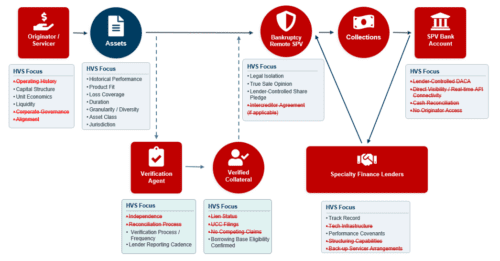
7 Sources: HighVista Analysis, aggregated from a range of sources including, but not limited to,AltsWire, Alter Domus, Bloomberg.
8 Red indicators within the diagram denote structural controls identified as absent or inadequate based on publicly reported information and court filings. Green indicators denote controls assessed as present and functioning. This illustration is provided for informational purposes only and reflects HighVista’s analytical assessment of publicly available information.
Conventional Mitigants and Their Limits
The conventional industry response to these failures is to layer in additional oversight infrastructure: third-party verification agents, independent auditors, custodians, enhanced audit rights, and field exams. These mitigants are directionally correct, and we seek to evaluate transactions with these criteria in mind. The fundamental constraint, however, is two-fold. First, layering verification agents, custodians, and independent auditors into a facility carries a direct per-asset cost that erodes net yield materially, making it structurally difficult for a lender who insists on the full suite of conventional controls to clear at market terms. Second, implementing these controls requires complex intercreditor and agency documentation that slows execution materially and runs counter to the covenant-light terms that characterize the competitive lending environment, particularly at the upper end of the market. The result is that conventional mitigants provide protection at the margin while leaving the core structural vulnerabilities intact. The question is not whether those vulnerabilities can be addressed, but whether the industry can develop the tools to remove these frictions entirely, making rigorous oversight economically viable at scale rather than a competitive penalty.
Part IV – HighVista Response
Having identified specialty finance as an attractive thematic opportunity in 2025, HighVista has been actively investing in the space, concentrating our activity in the early and late growth stages of the originator lifecycle where we believe the risk-adjusted opportunity is most compelling. Our focus on transactions sized between $25 million and $100 million positions us in a segment where specialized asset-level underwriting capabilities are a prerequisite for participation, and where the competitive dynamics continue to ease.
The forensic analysis in Part III points to a clear conclusion: the conventional toolkit of audits, verification agents, custodians, and field exams is directionally correct but structurally insufficient. In each fraud case we examined, the originator controlled the data tape and lenders had no independent, real-time mechanism to verify what was on it. In our view, the answer is not more intermediaries. It is direct access.
Our approach is built around two structural responses to the vulnerabilities Part III identifies. The first is technology. Where conventional oversight relies on periodic, borrower-reported data, we seek direct API connectivity into SPV bank accounts and collateral accounts in our transactions, enabling continuous cash reconciliation tied back to the originator’s own ledger in real time. In our view, this is the mechanism that resolves the data tape problem: it removes the originator’s unilateral control over what lenders see and replaces it with independently accessed, continuously updated visibility into actual pool composition and cash movement. The fraud window that allowed Tricolor’s fabrications to survive a public securitization and Broadband Telecom’s receivables to accumulate $500 million in lender exposure is a function of the gap between what borrowers report and what lenders can independently verify. Real-time API connectivity helps close that gap structurally rather than procedurally.
The second is bilateral structure. We favor structures where each facility is the borrower’s sole warehouse arrangement against a clearly defined collateral pool, with one lender setting and enforcing verification standards without dependency on the coordination of other capital providers. The defining vulnerability in both case studies was not the presence of multiple lenders, but the existence of multiple separate, uncoordinated facilities against the same collateral pool, where no single lender had visibility into the totality of encumbrances against the underlying assets. Where multiple lenders participate in a single facility governed by a common intercreditor framework and a shared, clearly defined borrowing base, that coordination risk is materially reduced. In a sole-facility structure, standards are set and enforced without intercreditor dependency entirely, and a lender-controlled DACA provides direct and continuous visibility into the collateral pool and collections as received, making double pledging structurally unlikely against our position.
These two responses are the operational expression of what the Security pillar was designed to achieve: a structure in which the lender, not the originator, controls the verification of collateral existence, exclusivity, and cash movement on a continuous basis. It bears emphasis that neither response, nor any combination of structural protections, eliminates the risk of bad actors entirely. The intent of this framework is not to claim otherwise; it is to identify the structural conditions that have historically allowed control failures to go undetected and to raise the bar against them materially.
The market’s instinct is to treat scale and track record as proxies for safety. At the upper end of the market, where syndicated structures are the norm and no single lender controls the verification infrastructure, the two root causes are most difficult to address. At the upper end of the market, larger and more mature originators present a compounding problem: tighter spreads that reduce the return available to disciplined lenders, and capital structures of materially greater opacity, where the proliferation of off-balance-sheet financings and intercreditor complexity makes independent verification of collateral exclusivity structurally harder, not easier. In our view, the lower middle market, by contrast, is where the conditions for disciplined oversight are achievable, with bilateral structures, tech-forward counterparties with the systems infrastructure to support real-time data connectivity, and transaction sizes where we can demand and enforce the protections that larger facilities routinely negotiate away.
Conclusion
Our view remains that specialty finance is one of the most structurally compelling forms of private credit available to institutional investors. By lending directly against discrete, self-amortizing pools of contractual cash flows, in our estimation lenders are positioned closer to the underlying economic activity than in virtually any other form of private credit, with a contractual architecture for enforcement and a path to capital recovery that does not depend on enterprise value realization or refinancing markets. The “fraud wave” of 2024 and 2025 exposed something specific and addressable: the structural protections specialty finance affords are only as effective as the infrastructure lenders use to enforce them.
Closing that infrastructure gap requires lenders who arrive at the transaction with the technology to impose direct API connectivity into SPV bank accounts, billing systems, and collateral management platforms. The next generation of specialty finance will not be defined by originators with better technology. In our assessment, it will be defined by lenders who treat real-time verification infrastructure as a non-negotiable condition of participation.
We are actively partnering with originators who have the systems infrastructure to support that standard today and who are building toward the next wave of innovation in collateral verification. We do not believe technology eliminates bad actors. We believe it raises the bar for control failures and helps collapse the detection window in which undetected fraud can cause material economic damage. The firms that define the next generation of specialty finance will not be those that retreated from the asset class during this dislocation. They will be those that treated it as a diagnostic, identified precisely where structures broke, and built the infrastructure required to address those failures at the transaction level.